Instant Vision Particles Company
for Physical & Chemical Testing LLC
Engineering Architectures
for Measurement,
Validation,
and Operational Stability
Telecommunications Division
Under Development

Next-Generation Physical Measurement and
Characterization
Informational scientific media illustrating a real-time, ultra-low-noise physical measurement architecture based on stability-first measurement engineering, presented for scientific and engineering purposes only.
IVP-Lab™ (Instant Vision Particles Company for Physical & Chemical Testing LLC) is a research-oriented laboratory initiative focused on stability-governed physical measurement, validation, and advanced characterization. The central question in advanced measurement science is not only how strong a signal is, but what fundamentally determines whether a measurement can be trusted.
The central question in advanced measurement science is not how strong a signal is, but what fundamentally determines the reliability, trustworthiness, and scientific validity of a measurement.
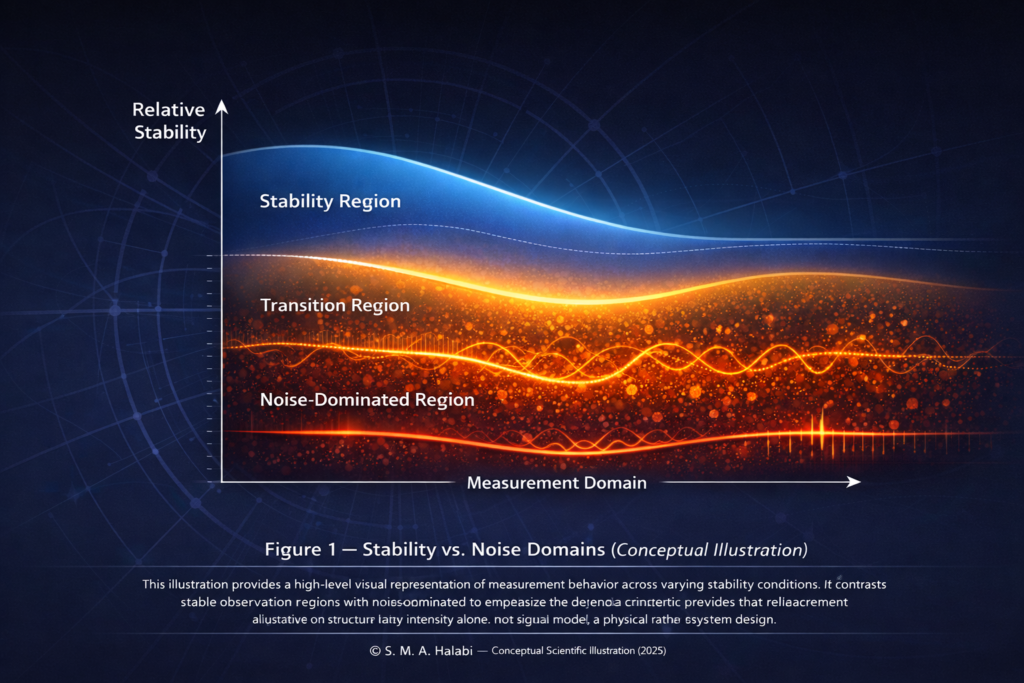
- Figure 1 — Stability vs. Noise Domains (Conceptual Illustration)
- This conceptual illustration presents a high-level visualization of measurement behavior under varying structural stability conditions. It contrasts regions in which observations remain stable, interpretable, and decision-relevant with regions dominated by noise, where measurement outputs may appear numerically valid yet lack physical reliability. The purpose of this figure is to communicate a foundational principle recognized across advanced measurement science: the integrity of measurement is governed primarily by structural conditions of the system and its environment, rather than by signal intensity alone.
- Within stable domains, observational results maintain coherence, interpretability, and analytical value, enabling measurements to function as dependable inputs for engineering evaluation, scientific interpretation, and technical decision-making. In contrast, noise-dominated environments impose intrinsic limits on measurement validity, where increasing signal magnitude does not necessarily improve accuracy or confidence, and may in some cases amplify ambiguity rather than reduce it.
- The transition region shown between these domains represents the qualitative boundary at which measurement outcomes shift from structurally reliable to conditionally uncertain. This boundary is depicted conceptually and does not imply a fixed threshold, quantitative model, or operational specification. Instead, it serves as a visual representation of the general principle that measurement performance must be understood as an architectural property of the system rather than as a direct function of signal strength.
- This illustration is intentionally presented as a conceptual communication graphic. It is designed to clarify a scientific perspective on measurement stability at an abstract level and does not disclose system design, experimental configuration, analytical methodology, or implementation architecture. Its role is explanatory rather than technical, providing a visual framework for understanding the broader philosophy that governs stability-driven measurement approaches.
- © S. M. A. Halabi — Conceptual Scientific Illustration (2025)
Fundamental Constraints in Measurement Reliability
- Scientific Origin & Authorship
- Saleh Mohamed Ibrahim Hajeh Alhalabi is an independent physics researcher and scientific author whose work develops original conceptual frameworks and foundational architectural models concerned with measurement validity, structural stability, and physical observability under real-world conditions. His research is centered on identifying the governing principles that determine when measurements can be considered physically interpretable, decision-relevant, and scientifically reliable.
He is the originator of structured theoretical frameworks, including:
- PEQSF™ — (P—Phase, E—Entanglement, Q—Quantum, S—Spacetime, F—Fabric)A conceptual scientific framework investigating phase-coherent physical domains and their relationship to stability-driven observability.
- OPET™ — (O—Onto, P—Phase, E—Engineering, T—Technology)An engineering methodology designed to translate abstract scientific constructs into system-level architectures suitable for controlled evaluation, structured development, and technical interpretation.
- His contributions are theoretical and architectural in nature, focusing on foundational scientific structures rather than product-level implementations or device-specific disclosures.
- All conceptual frameworks, scientific structures, and theoretical architectures presented on this platform are original works authored and exclusively owned by him.
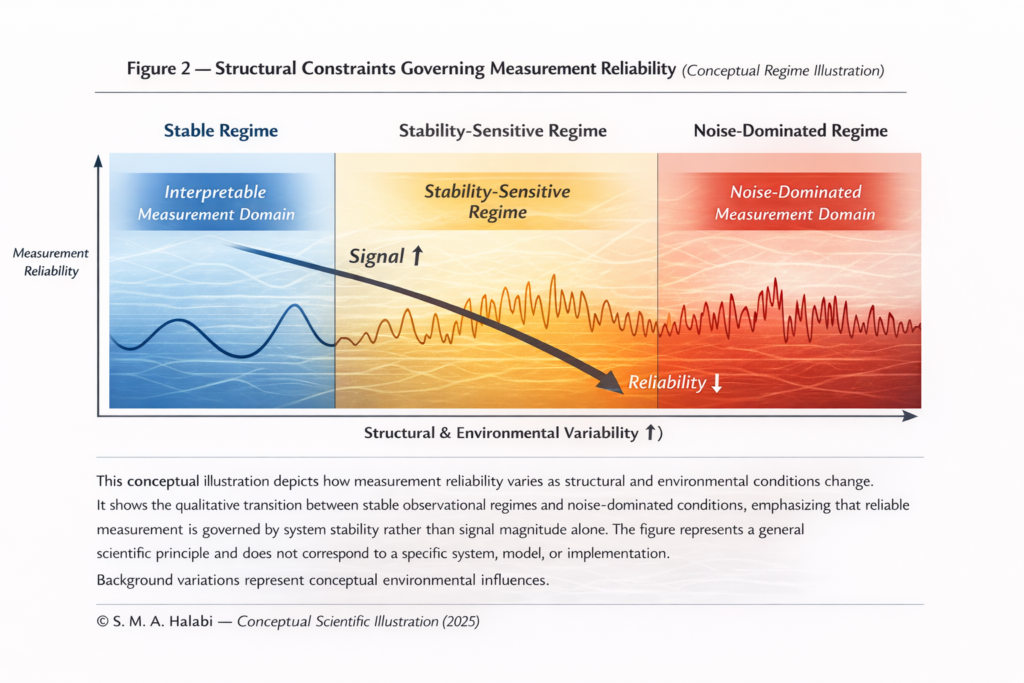
- Figure 2 — Structural Constraints Governing Measurement Reliability (Conceptual Regime Illustration)
- This conceptual illustration depicts how measurement reliability varies as structural and environmental conditions change. It visualizes the qualitative transition between stable observational regimes and noise-dominated environments, highlighting a well-established scientific principle: reliable measurement outcomes are fundamentally governed by system stability rather than signal magnitude alone.
- Within structurally stable conditions, observations remain interpretable, consistent, and decision-relevant. As variability increases, measurement behavior enters a sensitivity regime in which interpretability becomes conditional on underlying stability. In noise-dominated environments, measurement outputs may still appear numerically defined while lacking physical decisiveness, illustrating the intrinsic limitations imposed by structural conditions.
- The regions illustrated are conceptual and not drawn to scale. This figure represents a general scientific principle intended for explanatory purposes only and does not describe any specific system, implementation, or measurement architecture.
- Background variations represent conceptual environmental influences.
- © S. M. A. Halabi — Conceptual Scientific Illustration (2025)
Architectural Response to Measurement Constraints

- Figure 3 — Architecture-Level Stabilization Framework (Conceptual Systems Illustration)
- This conceptual illustration extends the progression established in the preceding figures by presenting an architectural perspective on measurement reliability. While earlier sections demonstrated that measurement outcomes are governed by structural stability and constrained by environmental variability, this diagram introduces a systems-level viewpoint in which stabilization is positioned as a governing layer between external conditions and measurement interpretation.
- In this representation, reliability is not treated as a consequence of signal magnitude or post-processing refinement, but as a structural property emerging from controlled system conditions. By depicting stabilization as an intermediate architectural layer, the figure emphasizes a broader scientific principle recognized across advanced measurement disciplines: interpretable observation depends fundamentally on the conditioning of the physical context in which measurement occurs.
- The diagram is presented for conceptual communication only. It does not represent a specific device, configuration, or implementation, but rather illustrates a general architectural perspective consistent with established principles in measurement science and system-level analysis.
- © S. M. A. Halabi — Conceptual Scientific Illustration (2025)
Implications for Measurement Science
- The conceptual progression presented above suggests a broader understanding of measurement reliability in complex physical environments. Rather than interpreting performance limits as solely signal-bound phenomena, the preceding analysis indicates that reliability is structurally conditioned by the stability and coherence of the physical system within which observation occurs.
- This perspective implies that enhancements in measurement performance may arise not only from increasing signal intensity or computational refinement, but from addressing architectural conditions that govern stability prior to measurement interaction. In this sense, reliability emerges as a systemic property rooted in structural conditioning rather than as a post-detection adjustment.
- Such an interpretation aligns with established principles across advanced metrology, systems engineering, and observational physics, where environmental control, structural coherence, and stability modeling are recognized as foundational determinants of interpretability.
- The implications outlined here are conceptual and analytical in scope, intended to clarify general scientific considerations rather than to describe any specific device, configuration, or proprietary implementation.
Conceptual Outlook
- The conceptual framework presented throughout this page suggests a broader re-evaluation of how measurement systems are understood in structurally complex environments. Rather than viewing performance enhancement as a linear extension of signal strength or algorithmic refinement, this perspective encourages consideration of measurement as a stability-conditioned phenomenon rooted in architectural design.
- Future developments in advanced sensing and observational platforms may increasingly depend on systemic coherence, environmental conditioning, and structural integrity as foundational parameters of reliability. In such contexts, measurement performance becomes inseparable from the physical organization of the system itself.
- This outlook does not propose a specific technological path, but highlights a directional principle: that progress in high-precision measurement may emerge from structural conditioning strategies that precede and govern observational interaction.
- The ideas presented here remain conceptual and analytical in scope, intended to frame scientific inquiry rather than to disclose technical implementations.
Services
Decision-Oriented Measurement Services
IVP-Lab™ provides measurement services specifically designed to support engineering decision-making under physical uncertainty. Our work focuses on:
Measurement qualification, ensuring that experimental outcomes are structurally capable of discriminating between competing physical interpretations.
Uncertainty-to-decision mapping, where uncertainty bounds are explicitly linked to design, validation, or risk acceptance thresholds.
Interpretational validity assessment, identifying cases where measurements are numerically consistent yet physically non-decisive.
Traceable and verifiable testing frameworks, ensuring that measurement validity is demonstrable, auditable, and decision-relevant.
These services are intended not to increase measurement volume, but to ensure that measurement outcomes can legitimately support high-confidence engineering actions.
Measurement & Detection Systems
Description:
Measurement and detection systems are treated as integrated physical–laboratory structures, not as isolated sensing elements. Uncertainty sources are systematically characterized, and a clear separation between physical signal and noise is enforced to ensure measurement stability, traceability, and verifiable integrity prior to any engineering or regulatory decision use.
Instrumentation & Calibration Discipline
Description:
Instruments are managed within an engineering discipline that treats calibration and verification as continuous processes. Calibration outcomes are explicitly linked to the actual measurement context, ensuring system-level coherence and preventing the isolated interpretation of individual device performance.
Artificial intelligence is employed as an operational support layer aimed at improving system utilization rather than as a source of physical truth. AI applications operate outside the measurement core, supporting scheduling, anomaly detection, and efficiency optimization without transferring epistemic authority from physics to algorithmic inference. Economic benefit arises from reduced redundancy, extended system lifespan, and controlled operational optimization.
Data Acquisition & Analysis
Description:
Data acquisition pathways are designed to preserve the physical meaning of measurement while explicitly characterizing sources of uncertainty. A deliberate separation is maintained between computational processing, physical characterization, and engineering interpretation, ensuring repeatability, independent verification, and analytically defensible outcomes.
Safety & Operational Environment
Description:
Operational safety is embedded in the measurement design, ensuring protection of personnel and the environment while minimizing non-physical sources of experimental error. These principles are applied consistently across both laboratory-controlled and field-deployed testing environments.
Secure Engineering & Cyber-Resilient Design
Engineering security is integrated into the measurement system from its foundations to protect data integrity, prevent manipulation, and ensure scientific and regulatory defensibility of measurement outcomes. System architectures enforce separation between physical, laboratory, and informational layers to maintain measurement validity under complex operational conditions.
Example: AI-Assisted Utilization Strategy
Measurement systems are treated as long-term engineering assets whose value is determined by their ability to reduce decision risk rather than by short-term device cost. Sustainable economic value is achieved through stability, precision retention, efficient utilization, and reduction of the cost associated with incorrect or unjustified decisions.
User & Stakeholder Value
Value is realized through improved decision quality and reduced uncertainty across multiple stakeholder groups. Regulatory and governmental bodies benefit from traceable and defensible measurements, financial institutions gain access to high-integrity data supporting risk assessment, and industrial and research users achieve efficiency gains and reduced waste through valid, decision-relevant measurement.
Validation & Decision Integrity
Validation mechanisms are embedded within the experimental process to ensure decision integrity. Internal verification gates prevent the release of results that are experimentally correct yet decisionally inappropriate, ensuring scientific accountability, procedural consistency, and defensibility of all reported outcomes.