Applications

System-Level Stability Governance for Mission-Critical Architectures
IVP-Lab™ does not rely on incremental amplification as a strategy for performance advancement.
We address the structural origin of measurement instability at the architectural level.
Across aerospace platforms, high-sensitivity defense systems, laboratory-grade metrology, and advanced sensing environments, performance ceilings are no longer defined by signal magnitude. They are defined by architectural noise propagation, environmental coupling, and systemic instability layers embedded within conventional designs.
Our engineering position is structural, deliberate, and non-negotiable:
Measurement integrity must be stabilized before amplification.
Scalability must be architected before deployment.
This is not an enhancement layer applied after distortion occurs.
It is a disciplined architectural restructuring of measurement logic at the system level.
Where conventional paradigms increase gain to offset instability, we reduce instability at its structural source.
Where amplification escalates risk, we constrain propagation.
Where post-processing compensates, we engineer pre-conditioning.
We do not attempt to overpower systemic instability.
We engineer systems in which instability is structurally governed.
This architecture-first doctrine is structured for environments in which mission assurance, lifecycle stability, and long-duration coherence preservation define success more fundamentally than signal intensity alone.
The objective is not higher amplitude.
The objective is deterministic stability under operational constraint.
Stability is not an output.
It is an engineered condition.
And in mission-critical systems, engineered stability defines the boundary between performance and failure.
This governing principle determines the operational environments in which IVP-Lab™ engages.
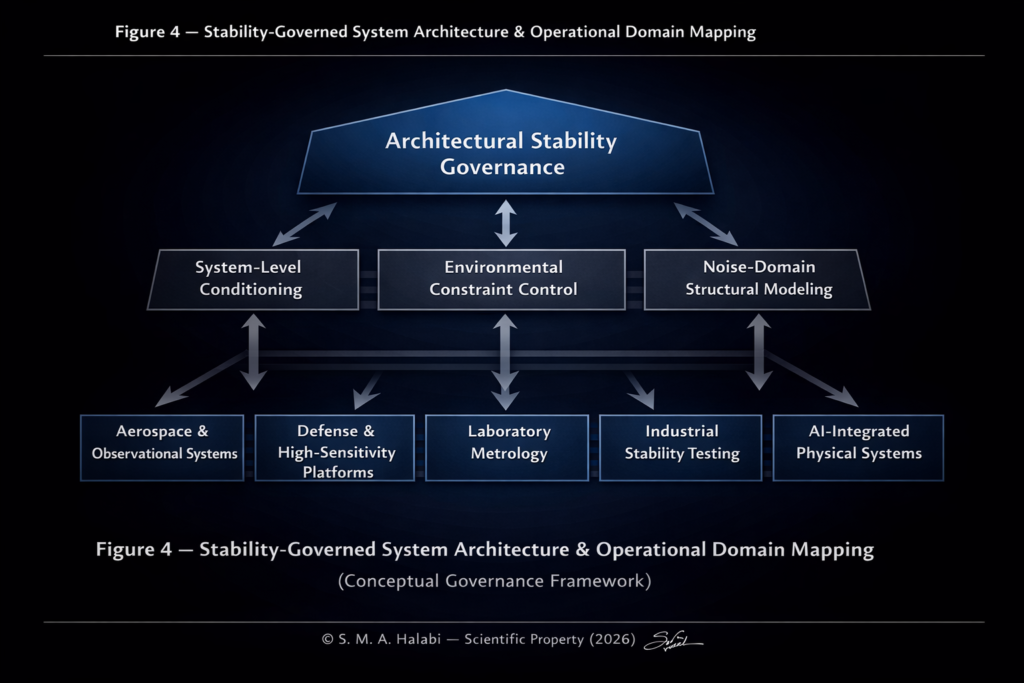
Operational Application Domains Governed by Stability-First Architecture
Operational domains within IVP-Lab™ are not defined as isolated industrial sectors, but as stability-governed extensions of a unified architectural framework.
As illustrated in Figure 4, Architectural Stability Governance operates as the central conditioning layer through which system-level stabilization, environmental constraint control, and noise-domain structural modeling are integrated prior to operational deployment.
This architecture-first approach ensures that measurement integrity, system reliability, and interpretational coherence are structurally governed before amplification, scaling, or mission integration occur.
Rather than compensating for instability after distortion emerges, IVP-Lab™ conditions operational environments at the architectural level, reducing instability propagation at its structural origin.
Accordingly, the application domains presented below represent governed operational environments mapped through stability-first engineering logic, not conventional amplification-dependent deployment paradigms.
Stability-Mapped Operational Domains
This section presents the operational environments derived from the stability-governed architectural framework illustrated in Figure 4.
Each domain reflects a stability-conditioned deployment context in which measurement integrity, environmental control, and structural noise governance are treated as primary engineering parameters rather than secondary compensatory factors.
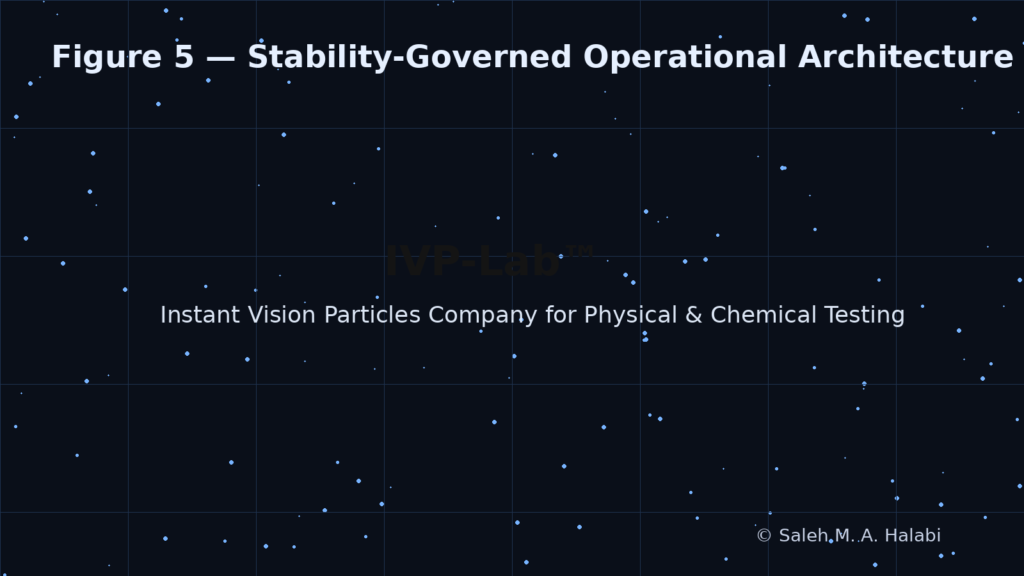
1) Advanced Laboratory & Metrology Environments
IVP-Lab™ architectures are structured for laboratory-grade environments where reproducibility, calibration integrity, and environmental isolation directly determine experimental validity.
Stability conditioning is implemented prior to interpretation and data-layer processing, reducing structural noise propagation and enabling traceable, repeatable measurement behavior under controlled scientific conditions.
2) Aerospace & Mission-Critical Observational Systems
Applicable to high-sensitivity platforms operating under thermal variability, vibration exposure, and long-duration operational constraints.
The stability-first architecture governs coherence preservation, environmental constraint control, and structural noise containment without reliance on amplification-heavy compensatory regimes.
3) High-Sensitivity Industrial & Defense-Grade Testing Domains
Designed for operational environments where systemic instability, integration constraints, and environmental coupling directly influence detection reliability and system performance.
Architectural stability governance ensures deterministic measurement chains, reduced instability propagation, and mission-critical robustness under complex operational stress conditions.
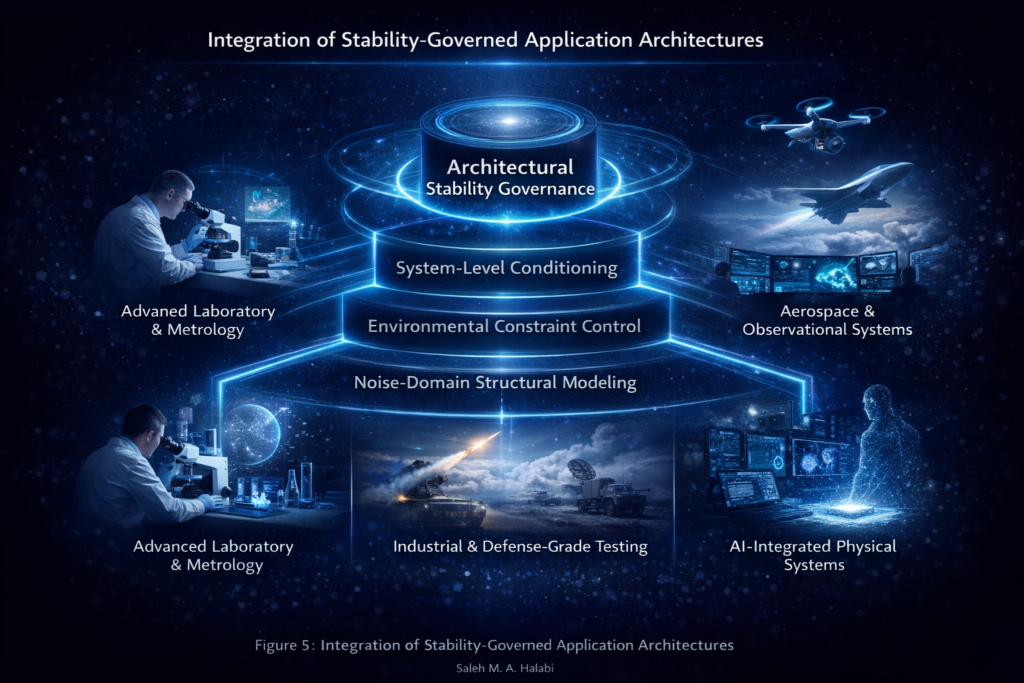
Conceptual Diagram
Strategic Closure — Stability as the New Performance Frontier
In mission-critical scientific and engineering systems, the limiting factor is no longer signal strength, computational power, or incremental hardware scaling. The decisive boundary has shifted toward structural stability, environmental coupling control, and architecture-level noise governance.
IVP-Lab™ positions itself precisely at this inflection point.
The framework presented across the preceding sections and figures establishes a coherent engineering doctrine: performance must be stabilized at the architectural layer before amplification, interpretation, or operational deployment. This is not a conceptual preference, but a systems-level necessity for next-generation aerospace, defense, laboratory metrology, and ultra-sensitive sensing infrastructures.
For organizations operating at the frontier of advanced research and mission assurance — including space agencies, defense innovation programs, and deep-technology laboratories — the challenge is no longer detecting stronger signals, but preserving measurement integrity under complex, high-variability conditions. Conventional amplification-heavy paradigms increasingly amplify instability alongside signal, introducing systemic distortion, interpretational ambiguity, and lifecycle reliability risks.
The stability-governed architecture introduced here addresses that root constraint directly.
Instead of compensating after instability propagates, it conditions the measurement environment, governs structural noise domains, and enforces deterministic stability chains prior to data interpretation.
This shift represents a transition from reactive sensing to governed observability.
From post-processing correction to pre-measurement integrity engineering.
From performance escalation to stability-determined reliability.
Accordingly, IVP-Lab™ does not present incremental technological upgrades, but a structural engineering position aligned with the emerging needs of high-assurance scientific and industrial ecosystems. The illustrated architectural mapping and application domains demonstrate a unified, scalable logic suitable for long-duration missions, high-sensitivity experimental platforms, and next-generation physical analysis systems where stability, not amplitude, defines operational success.
For institutions such as NASA, DARPA, IBM Research, and other advanced R&D entities, the implication is direct: future measurement superiority will not be achieved by pushing systems harder, but by stabilizing them deeper at the architectural level.
Stability is no longer a secondary optimization parameter.
It is the governing infrastructure of reliable observability.
And in the era of ultra-sensitive physics, quantum-informed engineering, and mission-critical technological systems, architectures that structurally govern instability will define the next generation of scientific capability, operational resilience, and invention-grade technological advancement.
© Saleh M. A. Halabi — Stability-Governed Systems Positioning (2026)
Stability-Mapped Operational Domains
This section defines the operational environments derived from the stability-governed architectural framework illustrated in Figure 4.
Each domain represents a stability-conditioned deployment context in which measurement integrity, environmental constraint control, and structural noise governance are treated as primary engineering parameters rather than secondary compensatory factors.