Research
Stability-Dominant Measurement Research
Addressing Limits of Amplification-Dependent Sensing
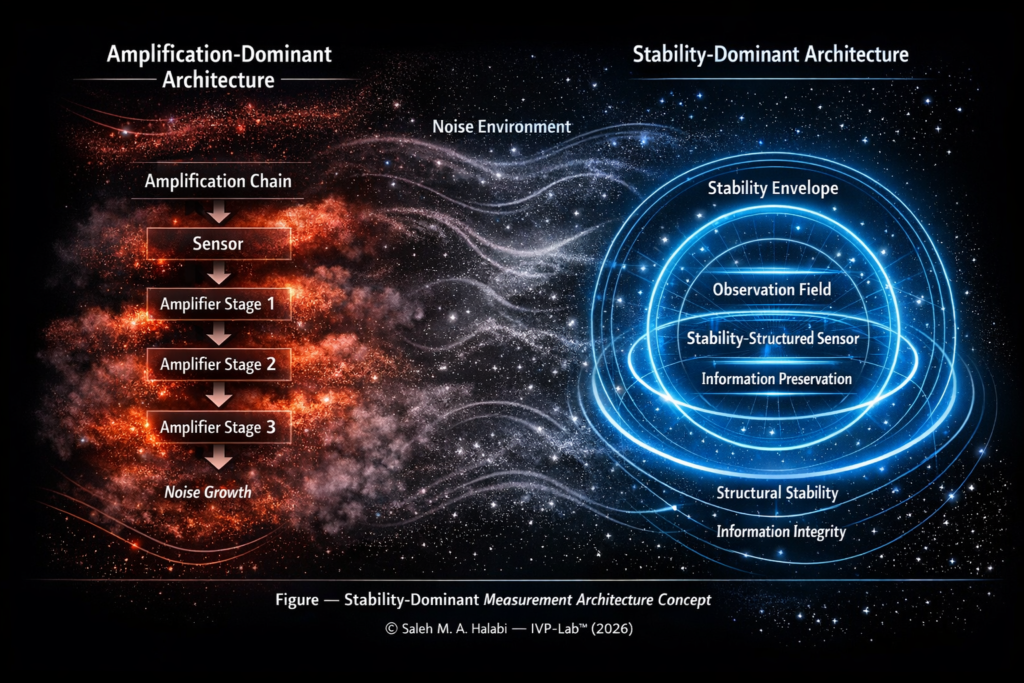
The research program conducted within IVP-Lab™ extends directly from the architectural philosophy described in Who We Are. The central premise guiding the laboratory’s work is that measurement reliability emerges from structural stability, environmental awareness, and disciplined control of noise behavior at the architectural level.
Rather than pursuing performance primarily through amplification scaling, power escalation, or increasingly complex post-processing pipelines, the research direction investigates stability-dominant measurement architectures capable of preserving informational integrity at the earliest stages of physical observation.
This architectural orientation reflects a shift in measurement philosophy:
stability is treated as the primary design variable rather than as a secondary corrective challenge.
Architectural Research Foundation
The research foundation of IVP-Lab™ is based on the principle that measurement integrity is fundamentally an architectural property.
The laboratory investigates sensing architectures that treat the following elements as first-order design variables:
- structural stability across operational time scales
- environmental coupling between measurement systems and their surroundings
- noise behavior within cascaded measurement chains
- preservation of informational content at the acquisition stage
- scalability of sensing systems without proportional instability growth
These considerations form the architectural basis for ongoing research within IVP-Lab™.
Future Positioning
Beyond Amplification-Dependent Measurement Paradigms
Many modern sensing technologies attempt to extend performance through higher gain, increased power density, or advanced compensatory filtering. While these approaches can produce incremental improvements, they may also introduce new instability mechanisms and increased sensitivity to environmental perturbations.
The research direction of IVP-Lab™ therefore examines sensing architectures in which performance improvements are pursued through structural stability and coherence preservation, rather than through amplification escalation alone.
This research direction does not claim replacement of established RF or classical sensing technologies. Instead, it seeks to complement existing systems by addressing structural performance limits that arise when amplification becomes the dominant design strategy.
Experimental Methodologies
Integrity-First Measurement Structuring
Experimental work within IVP-Lab™ follows an integrity-first research methodology designed to preserve measurement reliability prior to interpretive processing.
The laboratory structures experimental investigation around:
- stability-governed experimental configurations
- identification of structural noise sources within sensing architectures
- environmental coupling awareness in experimental setups
- repeatability-oriented experimental validation
- calibration-conscious measurement protocols
These principles support the development of sensing architectures capable of maintaining observational reliability under complex environmental conditions.
* Measurement Precision & Reproducibility
Metrology-Aware Research Orientation
In many conventional sensing pipelines, precision improvements are pursued through increased amplification or computational compensation. The research approach within IVP-Lab™ instead treats precision as an emergent property of structural stability.
Key considerations include:
- suppression of instability growth during system scaling
- architectural control of environmental perturbation pathways
- preservation of informational integrity during signal acquisition
- repeatability and reproducibility across controlled measurement conditions
- uncertainty-aware evaluation of measurement reliability
Where appropriate, statistical stability metrics used in precision measurement science may be employed to evaluate system behavior across time scales.
Table 5 — Foundational Limits in Measurement Science
| # | Scientific Principle | Relevance to Measurement Systems | Representative Reference |
| 5.1 | Noise accumulation in cascaded amplification systems | Cascaded amplification stages introduce additional noise that fundamentally limits achievable signal fidelity in multi-stage sensing architectures | Friis, H. T. (1944) — Noise Figure of Radio Receivers |
| 5.2 | Information limits in noisy channels | The amount of recoverable information from a signal is constrained by channel noise and bandwidth limitations | Shannon, C. E. (1948) — A Mathematical Theory of Communication |
| 5.3 | Estimation limits (Cramér–Rao bound) | The variance of any unbiased estimator is bounded by the inverse of the Fisher information contained in observed data | Cramér–Rao bound (Statistical estimation theory) |
| 5.4 | Time-domain measurement stability | Long-term precision and reliability depend on statistical stability across time scales in precision measurement systems | NIST — Frequency Stability Analysis (Allan variance methods) |
Ongoing Research Directions
Non-Operational Overview
Current research directions pursued within IVP-Lab™ include:
- stability-dominant sensing architectures for complex operational environments
- architectural approaches to noise-domain governance
- structural suppression of error propagation in sensing chains
- coherence-aware measurement logic in observational platforms
- integration-aware sensing architectures for aerospace, defense, and laboratory environments
These research directions are explored within a framework designed to maintain scientific rigor while protecting proprietary architectural methodologies.
Research Outlook
Toward Future Physical Measurement Architectures
The ongoing research program within IVP-Lab™ aims to improve the structural integrity of existing sensing systems while exploring whether stability-dominant design principles could enable future classes of physical measurement architectures.
At the present stage, this work should be understood as an architectural research trajectory rather than a completed technological transition. Any future system-level developments will depend on experimental validation and disciplined laboratory investigation.
Scientific Communication & Disclosure Boundary
IVP-Lab™ maintains a disciplined approach to scientific communication.
Public materials focus on architectural principles and measurement philosophy. Operational system designs, implementation methodologies, and prototype developments remain subject to controlled collaboration frameworks and non-disclosure agreements.
© Saleh M. A. Halabi — IVP-Lab™ — Scientific & Engineering Property (2026)